



Federal investment has long underwritten a large share of the U.S. science and research enterprise. Under the Trump administration that investment has contracted, while remaining funds have been redirected toward the priorities of tech oligarchs and political loyalists. The result is not simply a change in research emphasis. It is a structural shift in who sets the federal science agenda and on what terms.
Chapter 1 of Forging the Future of Science and Democracy documented the underlying political motivations, strategy, and the scale of the damage. This chapter asks what follows from that record. Documenting harm is necessary, but it is not the same as ensuring that the people and decisions responsible for it face scrutiny, or that the same vulnerabilities do not remain available to the next set of political leaders. Accountability is the step that turns a catalog of losses into a constraint on future conduct
The accountability agenda presented in this chapter serves as both a synthesis and strategy resource that distills and organizes the existing public record into usable categories—decision points, actors, mechanisms of harm, and available levers—and converts that organization into concrete near-term pathways. For Congress, it supplies sourced targets and existing oversight tools that do not require new legislation. For the scientific community, it offers a shared set of realistic roles so that accountability becomes part of ordinary advocacy rather than an external demand.
Checks and balances in the U.S. system are not only preventive. They are also punitive. While some matters will be resolved in the courts, Congress and the public already possess mechanisms capable of producing scrutiny, protecting those who disclose information, and narrowing the structural openings that allowed the harm in the first place. This chapter maps those mechanisms and the strategy for using them.
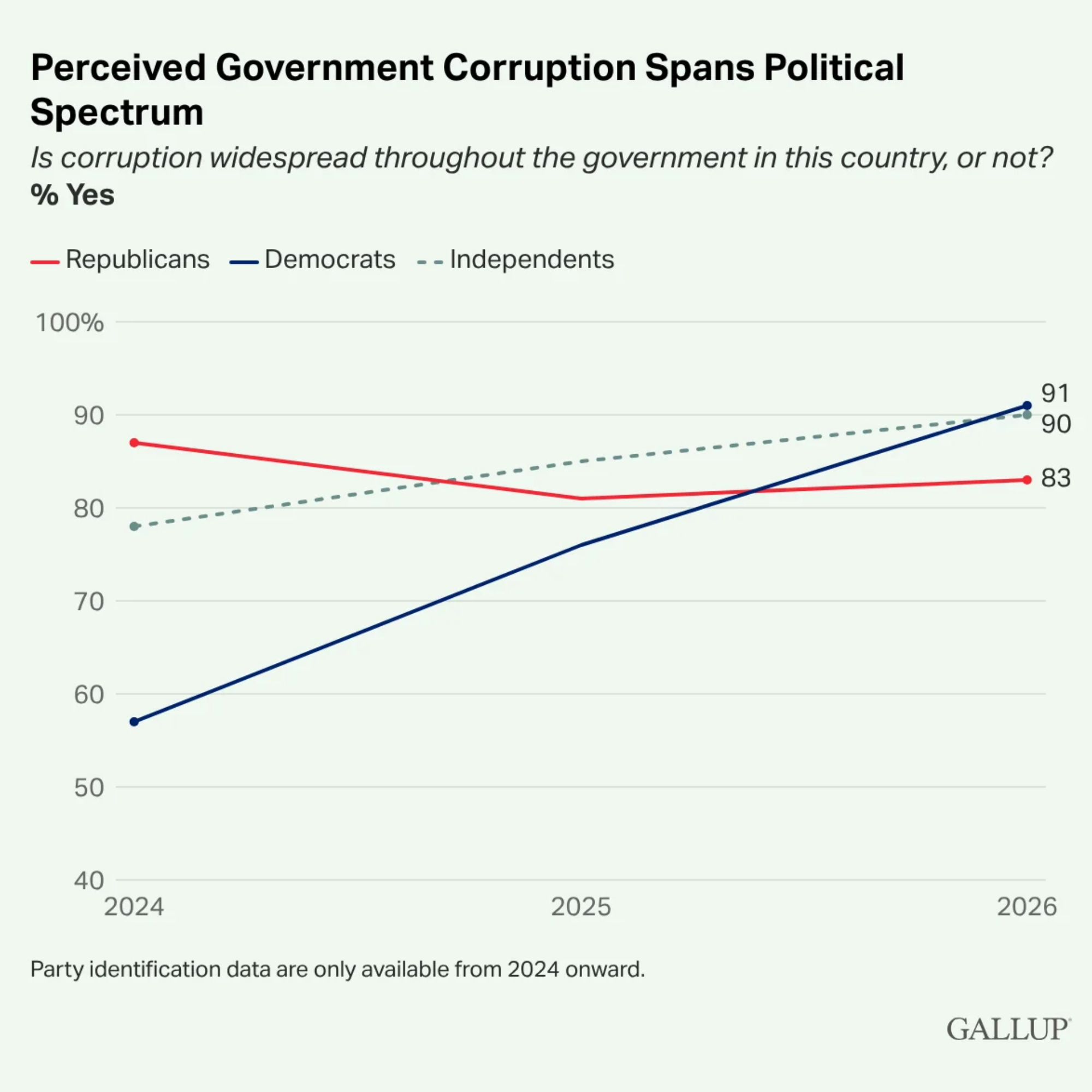
The corruption and abuse of power that have become hallmarks of the Trump administration have made visible a broader erosion of constitutional norms. The administration has repeatedly tested legal limits in order to extract maximum advantage from bending the machinery of government. Restoring those norms requires that accountability come first—before any discussion of structural reform. Accountability here is not a tool of retribution. It is the practical means of restoring law, order, and the basic tenets of democratic government to the institutions that have been bent. According to a 2026 Gallup poll, “Perceptions of government corruption are now higher in the U.S. than at any point in the past two decades and outpace most other countries, including advanced economies. While perceptions of corruption in business are also elevated, government corruption is seen as significantly more widespread” (figure 1)1. Congress and other public bodies would be wise to treat that concern as a mandate rather than a background condition.
This chapter focuses on the range of options and strategies that Congress and the scientific community can pursue together. The pathways outlined here are not prescriptions. They are concrete routes by which accountability can help safeguard the scientific enterprise and limit further erosion of scientific integrity.
Congress possesses broad investigatory power to oversee federal agencies and the way they function 2. That authority extends to scrutiny of both government and non-governmental entities whose actions have affected science and research. The chapter notes structural gaps that legislation could eventually address, but it does not center, endorse, or prioritize any specific bill. Near-term value comes from tools that already exist.
The goals are therefore practical and immediate:
Using existing oversight authorities, produce concrete congressional scrutiny of named actors, decisions, and incidents (both isolated and not),
Create protected, usable pathways for disclosures that can feed oversight, and
Give the scientific community a shared, realistic set of goals, so accountability becomes shared advocacy practice.
The focus is on the issues that have most directly affected the scientific community and the research enterprise. These include the erosion of scientific integrity, the suppression or censorship of certain types of science, the firing and removal of scientific experts, and blatant corruption. Accountability can be pursued through legal, congressional, public, institutional, and state-level pathways. Outside actors and influences, including major funders and donors, are included as targets or enablers where the public record supports it.
The scientific community’s role in pursuing accountability is critical. While Congress has broad powers to conduct oversight and investigations and to create the formal demand for accountability, the scientific community plays a critical role in informing and helping to shape that demand. It can do so proactively—by identifying decision points and actors with existing documentation, preparing witnesses and technical analyses in advance, and supporting protected disclosures that feed specific inquiries—rather than waiting to respond after oversight is already underway.
An accountability agenda needs both near-term and longer-term goals. Mechanisms such as legislation and impeachment remain part of the menu of options that Congress and the public can pursue, even though they are difficult to achieve and should be treated as longer-term aims rather than near-term expectations. Short-term goals are equally important. They can draw directly on the documentation and tracking already compiled over the past two years and convert that record into immediate scrutiny, protected disclosures, and other usable pressure. No single mechanism is sufficient on its own. The chapter therefore lays out a range of accountability tactics, with primary emphasis on those which address the following broad categories of harm to the scientific community and research ecosystem:
Erosion of scientific integrity
Political interference in scientific processes, weakening or dismantling of scientific integrity policies and officers, alteration or suppression of findings to fit preferred narratives, and changes that reduce the independence of peer review or advisory processes.Suppression and censorship of research
Termination or freezing of grants on ideological grounds, keyword-based screening, restrictions on certain topics (climate, public health, gender, DEI-related work, etc.), and barriers to publishing or disseminating results.Removal and displacement of scientific expertise
Firings, forced resignations, non-renewals, and mass departures of federal scientists and technical staff; dissolution or stacking of scientific advisory committees; and loss of institutional knowledge and capacity.Misuse of funds and redirection of the research agenda
Diversion of appropriated funds, insertion of political or industry priorities into grantmaking and program design, and redirection of resources toward tech-oligarch or other private interests at the expense of the broader scientific enterprise.Corruption and conflicts of interest
Pay-to-play arrangements, undisclosed or poorly managed conflicts involving political appointees or outside funders, and decisions that appear to trade scientific or regulatory outcomes for financial or political benefit (e.g. preferential treatment/conflict of interest in government contracting decision)
Accountability for the devastation inflicted upon the U.S. science and research ecosystem requires first addressing the political appointees who explicitly directed or otherwise enabled said damage. Agency leaders and senior officials are able to exercise authority over tactics to centralize power and delegitimize scientists described in our previous chapter, such as: directing funding decisions, replacing experts with loyalists, disregarding, disrupting or dismantling advisory bodies, restricting public access to information, and otherwise reshaping agency operations.
While these political appointees are often the catalyst for the devastation inflicted, responsibility for the harm—and thus, need for accountability—does not end there. Many career staff took their obligations to the American people seriously, speaking out against political interference and working to preserve the scientific integrity and public protections entrusted to their agencies. Among them were the Bethesda Declaration signatories, who worked with Stand Up for Science to publicly call on the National Institutes of Health leadership to acknowledge the harm inflicted by this administration and return to upholding the agency’s mission.3 This cannot be said, however, for all career staffers.
The recurring public discourse that individuals such as career staffers are “just following orders” therefore is deserving of scrutiny. Even at face value, there is no one singular way to “follow orders,” nor is it apparent that one should quickly disregard responsibility to the American people at the behest of a current political appointee leading the agency. Career employees have obligations to the law and the public their agencies serve—and federal law explicitly protects employees from retaliation for disclosures that are believed to show violations of law, mismanagement, waste and abuse, or a substantial danger to public health and safety.4
We must therefore determine where the line of complicity can be drawn and what criteria can be used to identify which individuals have crossed it. For example, what did the career staffer know about the likely consequences of “following orders”? What authority were they capable of exercising? Were concerns communicated, points of potential harm identified? Did they follow policy directives that were undeniably going to result in harm to the public? One can also weigh the risk to persons—loss of employment, health insurance, professional standing, and the ability to support one’s family are all harms that have been inflicted upon disobedient career staffers. It is thus important we weigh responsibility through a number of lenses, including overall impact to the American people, availability of knowledge of the harm, whether any dissent was attempted, and to what extent speaking out would have resulted in harm to the individual.
Accountability must also extend outside of typical government positions. Private actors and funders, for example, may influence agencies' priorities to benefit their personal interests, often at the expense of public welfare. This extends to the elusive in-between we witnessed with the Department of Government Efficiency,5 which brought the dangers of integrating private actors directly into the federal agency framework into sharp relief. Musk was able to massively disrupt federal agencies while retaining his extensive ties to federal contracts and regulation,6 raising legitimate concerns regarding whose interests DOGE’s decisions were actually serving.
In pursuit of accountability, Congress must seek to bring Robert F Kennedy Jr., Secretary of Health and Human Services, to the stand to answer for the devastating harm he has inflicted upon public health in the United States and beyond.
A Deep Dive on RFK Jr.’s Role in Damaging Scientific Integrity at HHS and Causing Harm to the Public
In pursuit of accountability, we begin with a single illustrative case—Secretary of Health and Human Services, Robert F. Kennedy Jr. He has used his position to dramatically reshape HHS, degrading its responsibility to to protect the health of the American people around his own distrust of the science in part produced by HHS itself. Accountability here involves highlighting how he ousted scientists and experts, attempted to manipulate scientific information, reduced access to care, and globally exported the consequences of his anti-scientific vaccine skepticism.
Ousting Scientists and Experts for Loyalists
In a betrayal of promises made during his confirmation period,7 on June 9, 2025, Kennedy dismissed all standing members of the Advisory Committee on Immunization Practices,8 a body designed to advise the CDC on U.S. vaccine recommendations. In their place he appointed his hand-selected replacements, several of which had personal records of spreading vaccine misinformation and otherwise opposing established vaccination policy—with little scientific expertise presently represented. Beyond centralizing power by hand-selecting appointees who were ideologically aligned, mitigating dissenting opinions, the ousted panelists also publicly warned that Kennedy’s actions would undermine the previously robust scientific process behind vaccine recommendations, and likely result in public distrust for the institutions responsible for making vaccines.9
The pressure to conform to Kennedy’s ideology extended well beyond ACIP. Ousted Director of the CDC Susan Monarez testified10 that Kennedy demanded she commit in advance to approving the ACIP nominations he planned to put forth, regardless of what expertise they may (or may not) have. Monarez also testified that Kennedy directed her to dismiss career officials associated with setting vaccine policy without cause. Monarez was then fired after less than a month in her position as director, a decision she testified was likely a result of her refusal to comply with Kennedy’s unethical demands.
By January 2026, federal officials also bypassed the usual ACIP review process in order to revise the childhood vaccine schedule to limit the number of vaccines recommended11 (and therefore, limit what was accessible12). On March 16, 2026, a federal court stayed this vaccine schedule revision, the appointments of the new ACIP members Kennedy hand-selected, and the committee’s votes. This court intervention specifically found the attempt to revise the vaccine schedule contrary to law, and additionally concluded that his reconstruction of ACIP likely violated federal law.13
More broadly, in March 2025, HHS publicly announced its plans to restructure, with the goal of gutting its workforce from 82,000 to 62,000 employees.14 Simultaneously, Kennedy was slashing essential public health programs. The consequences of this widesweeping gutting of employees quickly became tangible. In April 2025, Milwaukee officials were looking for federal assistance for concerns regarding lead hazards in public schools, only to learn that the CDC would be unable to support their request for assistance, given that its lead program had been eliminated.15
Attempts To Manipulate or Disregard Scientific Information
Under Kennedy’s leadership, HHS has failed to meet the bare minimum of standards of scientific rigor. For example, the May 2025 Make America Healthy Again (MAHA) report16 contained multiple references to nonexistent sources, and mischaracterized existing research17 in pursuit of Kennedy’s ideological agenda. Similarly, the Food and Drug Administration’s own AI tool “Elsa” generated non-existent studies.18 By federal research integrity standards, this is, at minimum, clear scientific misconduct.19
Under Kennedy, the CDC also rewrote its vaccine safety website to introduce uncertainty regarding whether vaccines cause autism20—a question that is well-answered by overwhelming evidence that there is no link between the two.21 In a similar vein, Kennedy also demanded that a large Danish study be retracted,22 as it found no association between aluminum-containing childhood vaccines and the disorders examined in the study—findings that run contrary to Kennedy’s unscientific claims that aluminum in vaccines are dangerous.23
Kennedy is in fact a highly prolific spreader of vaccine misinformation—so much so that he was named as a part of the “Disinformation Dozen,” twelve individuals who are responsible for a majority of vaccine misinformation.24 His lies additionally include inflating the number of vaccines children receive and falsely claiming vaccines are tested for safety.25 That the secretary of Health and Human Services is spreading this health misinformation is both a direct threat to our vaccine accessibility, and a major threat to public adoption of vaccination. For example, Measles vaccination rates have been steadily falling,26 resulting in a notable uptick in Measles cases in recent months.27
Kennedy additionally killed a huge body of life-saving research funded by the NIH. This gutting of research additionally extended well beyond clinical studies in trial phases—an analysis by the Association of American Medical Colleges in October 2026 identified at least 5,776 NIH grants that were frozen or ultimately terminated since January 2025.28 Kennedy specifically cancelled $500 million in funding across 22 mRNA vaccine projects,29 while falsely claiming these vaccines failed to effectively protect against upper respiratory infections—a lie widely criticized by medical experts.
Reducing Access to Care
Under Kennedy, HHS also implemented additional barriers to marketplace coverage through changes to eligibility, verification, and reenrollment processes. The June 2025 Marketplace Integrity and Affordability rule included direct exclusions of DACA recipients from eligibility, as well as elimination of special enrollment periods for people with incomes at or below 150% of the U.S. federal policy level. The Centers for Medicare & Medicaid Services itself projected that this change would result in up to 1.8 million people losing their healthcare.30
This was not all Secretary Kennedy did to directly harm access to care in the United States. In July 2025, HHS ended specialized LGBTQ+ youth services within the 988 crisis hotline system. Additionally, an analysis of the previously-mentioned NIH grant terminations conducted during just the first half of 2025 identified at least 383 clinical trials affected by terminations, which cumulatively surmounted to at least 74,311 patients affected.
His impact additionally expanded outwards to countries beyond our own. In June 2025, Kennedy announced that the U.S. would cut off its contributions to the Global Alliance on Vaccine and Immunization Practices,31 falsely accusing it of disregarding safety. GAVI has helped vaccinate more than one billion children globally, preventing an estimated 18 million deaths worldwide. Experts warned at the time that this decision would cause over a million preventable deaths, as humanitarian groups like Doctors Without Borders described the decision as “cruel and reckless.”32 In July 2026, the administration has announced the release of $600 million in funding appropriated to GAVI, a decision contingent on GAVI acquiescing to transition away from thimerosal-containing vaccines. The World Health Organization (WHO) has warned that eliminating thimerosal from vaccines will increase costs and limit the availability of affordable vaccines, which will inevitably result in unnecessary deaths.33
Finally, Kennedy has repeatedly attempted to commit $1.6 million in U.S. taxpayer dollars to a deeply unethical study on the newborn hepatitis B vaccine in Guinea-Bissau,34 which would in turn delay deployment of this life-saving vaccine to a subset of newborns. Importantly, the hepatitis B vaccine has been well-established as safe and highly effective, and there is no scientific justification for the study. WHO publicly warned that withholding a proven intervention unnecessarily exposed infants to seriously and life-alerting irreversible harm.35
How Do We Hold RFK Jr. Responsible?
While these actions span a range from profound ethical failures to flagrant disregard for the law, their cumulative significance is clear. Kennedy has abused his position entrusted with protecting public health to instead undermine the institute itself, delegitimize science and scientists, erode public trust, and directly harm both the American people and those abroad with reductions in access to essential healthcare. In the case of Robert F. Kennedy Jr., appropriate accountability would at minimum include immediate impeachment and removal as Secretary of Health and Human Services. Stand Up for Science has pursued his impeachment and removal,36 including efforts to pass articles of impeachment through Congress,37 and will continue to do so until he is no longer in a position from which he can inflict such harm on the people he was intended to serve.
Given the blatant corruption and cronyism that has characterized the Trump administration,38 we anticipate that the list of oversight issues Congress will pursue will be extensive. Concerns related to the science and research enterprise represent only a subset of sectors, yet they should form an important part of any anti-corruption agenda that Congress and civil society pursue in the coming months. Science is a critical pillar of democracy—restoring its independence and integrity is essential to prevent further backsliding into authoritarianism and to mitigate the real damage being done to communities.
Holding the administration accountable will be no easy task and will require sustained effort by Congress, civil society, and the public. The administration has taken multiple steps to insulate political appointees from accountability, including the use of pardons, assertions of executive privilege, and reliance on expanded presidential immunity for official acts. These tools can narrow certain criminal and civil pathways, particularly for the highest-level officials and for actions taken within core presidential functions. They do not, however, create a general get-out-of-jail-free card. Presidential pardons apply only to federal offenses and do not reach state prosecutions, civil liability, impeachment, or congressional contempt. Immunity doctrines are limited to official acts and do not protect private or unofficial conduct. Most importantly, congressional oversight does not depend on criminal liability or the absence of a pardon.39 Committees can still compel documents and testimony, hold hearings, request Government Accountability Office audits, and refer matters to inspectors general or other bodies. The existence of insulation tactics makes early, documented scrutiny more important.
Congress has a breadth of options and oversight levers at its disposal. In this section, we outline several high-level priorities along with oversight mechanisms that Congress may consider deploying as it exercises its authority as an oversight body. These priorities are not meant to be exhaustive or prescriptive. Rather, those highlighted below directly address corruption and political interference in federally funded science. We’ve categorized some of the tactics and tools that it can deploy for each priority. The role of the scientific community here is critical to actively inform this process.
Political Interference in Science
Since early 2025, scientific integrity protections and the independence of peer review have been altered at both the National Institutes of Health and the National Science Foundation. At NIH, Director Jay Bhattacharya has overseen the introduction of term-based grant screening, changes to the weight given to peer review scores, and the termination of grants on the basis of research content. At NSF, Acting Director Brian Stone has led the agency after the resignation of the last Senate-confirmed director and after the President’s removal of the entire National Science Board, the statutory body that shares governance of the Foundation. During the same period, Office of Science and Technology Policy Director Michael Kratsios issued the implementing guidance for the May 2025 executive order “Restoring Gold Standard Science,” which directed agencies to revert scientific integrity policies to their pre-2021 versions and align them with the administration’s standards.40 In practice this has meant:
Consolidation of scientific and grantmaking functions under political appointees, reducing or eliminating the role of career scientists in decision-making.
Dismantling or sidelining scientific integrity officers and policies that had been strengthened under the previous administration. Agencies have removed or hollowed out public scientific integrity policies; some have been taken offline entirely.
Reducing the role of peer review. Guidance and proposed rules have treated peer review as merely advisory and given political appointees final authority over grant and research decisions that conflict with presidential priorities.
These are the policy changes the accountability agenda seeks to reverse or constrain: the substitution of political control for independent scientific process, the removal of integrity safeguards, and the demotion of peer and career review. The primary decision points for these changes sit at the White House and interagency level, particularly the Office of Science and Technology Policy (which issued the implementing guidance) and the Office of Management and Budget (which has driven proposed rules expanding political appointee authority over scientific and grant processes).
Oversight Pathways
Congress has treated the independence of scientific processes, the weight given to peer review, and the line between political direction and scientific assessment as legitimate subjects of oversight. The enacted policies noted above are therefore well within the established scope of congressional oversight. Congress can examine whether agencies are following existing authorizing statutes, appropriations conditions, and their own scientific integrity policies, and can scrutinize whether political criteria have displaced merit-based review. Congressional oversight—hearings, document demands, GAO referrals, and protected whistleblower pathways—can proceed concurrently.
Congressional hearing on implementation of the Gold Standard Science order and related changes to decision authority. EO 14303, released on May 23, 2025, charged the OSTP Director with issuing implementing guidance within 30 days and required agencies to align their scientific integrity and related policies with that guidance. The June 23, 2025, OSTP guidance, together with the agency policy revisions that followed, is the primary mechanism through which independence of process, peer review, and career scientific roles were altered.41 The hearing would examine how the responsible officials have exercised, or been directed to exercise, authority over scientific process, peer review, and integrity protections, and to establish a clear record of where decision-making now resides. Primary witnesses should include Michael Kratsios (OSTP Director, responsible for the guidance), Jay Bhattacharya (NIH Director, responsible for grant screening, peer review weighting, and content-based terminations), and Brian Stone (NSF Acting Director, who led the agency after the removal of the National Science Board). OMB officials involved in the consultation required by the order and in related grantmaking rules should also be included. Oversight authority sits with the House Committee on Science, Space, and Technology and the Senate Committee on Commerce, Science, and Transportation, with possible involvement of the House Oversight Committee or relevant appropriations subcommittees.
Referral to the Government Accountability Office. The committees of jurisdiction can request that GAO examine scientific integrity practices at NIH, NSF, and other science agencies under their oversight. A prior GAO review found that several HHS agencies lacked procedures defining political interference or describing how it should be reported and addressed.42 A new review can assess whether those procedures were implemented, how they were affected by the May 2025 order and subsequent policy reversions, and the current status of peer review weighting, grant screening, scientific integrity officer roles, and decision authority at NIH and NSF (including the effects of the National Science Board’s removal). This referral can proceed in parallel with the hearing and document demands.
Public release of correspondence regarding implementation on June 2025 guidance. The committees can release selected documents obtained through voluntary requests or subpoenas. Priority materials include OSTP drafts and clearance records for the June 2025 guidance, OMB consultation records, agency decision memos and emails implementing the order or revising scientific integrity and peer review policies, and communications showing how content screening or priority directives were applied at NIH and NSF. Selective release of the most probative documents, with appropriate redactions, makes the implementation chain public and usable by other committees, inspectors general, and the scientific community. Document demands can also proceed concurrently with the hearing and GAO referral.
2. Suppression and censorship of science
At NIH, the agency has used a list of roughly 235 terms, including “gender,” “climate change,” “equity,” and others, to screen both pending applications and already-awarded grants. Researchers whose projects are flagged have been required to remove or rephrase language in titles, abstracts, and public-facing materials or face termination or denial. This process is described in a September 2026 class-action complaint43, in an internal stipulation in which NIH’s head of extramural research acknowledged the use of search terms to identify grants expressing viewpoints the agency no longer wished to subsidize, and in guidance issued under Director Jay Bhattacharya that prioritizes certain research questions over others. The term list, the screening instructions, and the renegotiation or termination letters are agency records that committees can demand. Stand Up for Science has also documented the coercive practices of term removals in NIH grants.44
At CDC, political leadership has directed changes to public scientific products after they were produced. These include alterations to vaccine-related webpages, the removal or restriction of datasets containing specified terms, and the delay or rejection of a study scheduled for the Morbidity and Mortality Weekly Report while Bhattacharya was serving as acting CDC director. The MMWR episode is particularly concerning because the study had already cleared internal review, the decision to withhold it was made by named officials, and Bhattacharya later defended the action publicly by questioning the publication’s peer-review status.45
Oversight Pathways
Congressional oversight of alleged censorship in science can proceed through several established pathways. Relevant committees --particularly the House Energy and Commerce Committee, Senate Health, Education, Labor, and Pensions Committee, and the House and Senate Oversight Committees--have multiple tools at disposal to examine political interference in scientific products, webpages, datasets, and publications without requiring new statutory authority. There is direct precedent for this approach: the House Select Subcommittee on the Coronavirus Crisis (2020–2022) used document requests, subpoenas, and transcribed interviews to investigate political interference with CDC scientific reports, including efforts to alter or delay MMWR publications. The following are oversight pathways that Congress may consider:
Hearing focused on HHS content screening and alteration. Primary witnesses are Jay Bhattacharya (NIH Director) on the term list, screening process, and required language changes; the CDC Director (or the official who directed webpage and MMWR changes); and the HHS official who issued or cleared the relevant guidance. The question is factual and narrow: what criteria were used, who approved them, and how they were applied to grants and public products. Jurisdiction sits cleanly with the House Energy and Commerce Committee and the Senate HELP Committee. Recent documentation obtained by Democracy Forward shows that DOGE and the White House were involved in grant terminations at the National Science Foundation, contradicting OSTP Director Kratisos’s recent testimony to Congress.46
Document requests to HHS, NIH, and CDC. Priority records are the term lists and screening instructions, the emails and decision memos that required language changes or product alterations, and any communications between HHS political leadership and NIH/CDC on content criteria.
3. Corruption and Conflicts of Interest
Concentration of decision authority over scientific process and content has been accompanied by documented conflicts of interest and ethics issues among senior officials. At HHS, Secretary Robert F. Kennedy, Jr. entered office with ongoing financial ties that required ethics agreements. He initially retained a contingency-fee interest in Gardasil litigation referred to his former firm, Wisner Baum. After confirmation questions he amended the agreement, then later assigned the interest to the firm rather than to a family member as previously represented.47 His 2025 financial disclosure, filed late, reported $4 million in book advances and free travel. A September 2026 Campaign Legal Center complaint to the HHS Inspector General alleged that payments to his spouse’s production company from a MAHA-aligned organization may have violated his ethics agreement.48 These are specific, disclosable financial interests that intersect with his authority over vaccine policy, grant priorities, and scientific products.
At the agency level, non-competitive or politically-directed appointments and the use of public office to benefit aligned outside interests have also appeared. Examples include the replacement of institute leadership through processes outside ordinary hiring channels and the direction of grant and product decisions toward priorities associated with specific outside organizations or donors.49 In practice this has meant:
Failure to fully execute or accurately report ethics agreements covering contingency fees, book advances, and spousal business interests
Use of political or personal networks for senior scientific appointments outside standard processes
Direction of scientific or grant decisions in areas where senior officials or their close associates hold financial or organizational interests
These are the conflicts the accountability agenda seeks to constrain: the exercise of concentrated scientific authority by officials with unresolved or undisclosed financial interests.
Oversight Pathways
Congress has a duty to examine financial conflicts, ethics agreement compliance, and the use of public office for private or organizational benefit as core oversight subjects. These issues can be examined under existing ethics statutes, appropriations conditions, and the committees’ ordinary authority over HHS. The following are oversight pathways that Congress may consider:
Congressional hearing on ethics agreement compliance and conflicts affecting scientific decisions. The purpose is to examine whether senior HHS officials fully complied with their ethics agreements, how financial interests were disclosed and managed, and whether those interests intersected with decisions on grants, scientific products, or appointments. Primary witnesses should include the HHS Secretary (or the Designated Agency Ethics Official), the NIH Director, and the HHS Inspector General. Jurisdiction sits with the Senate Finance Committee, the Senate HELP Committee, and the House Energy and Commerce Committee. Congress should seek to obtain the HHS Secretary’s ethics agreements and financial disclosures, the HHS Designated Agency Ethics Official’s review of those agreements, and the appointment and priority-setting decisions at NIH and CDC that occur under that authority.
Referral to the HHS Inspector General and GAO. The committees can refer specific ethics agreement and disclosure questions to the HHS Inspector General for investigation. Concurrently, they can request that GAO examine conflict-of-interest screening, ethics agreement compliance, and the intersection of outside financial interests with scientific and grant decisions at HHS.
References
Vigers, B. (2026, September 2). Record-high 89% in U.S. say government corruption widespread. Gallup. https://news.gallup.com/poll/713933/record-high-say-government-corruption-widespread.aspx
Jenner & Block & Project on Government Oversight. (2025). When Congress Comes Calling: A handbook for responding to congressional investigations (2025 ed.). https://www.jenner.com/en/news-insights/publications/when-congress-comes-calling-a-handbook-for-responding-to-congressional-investigations-2025-edition
Stand Up for Science. (2025, June 9). The Bethesda Declaration: A call for NIH and HHS leadership to deliver on promises of academic freedom and scientific excellence. https://www.standupforscience.net/bethesda-declaration
U.S. Merit Systems Protection Board. (n.d.). Whistleblower questions and answers. https://www.mspb.gov/appeals/whistleblower.htm
U.S. Department of Government Efficiency. (n.d.). DOGE: Department of Government Efficiency. https://doge.gov/
Butler, D., Thadani, T., Martinez, E., Gregg, A., Melgar, L., O’Connell, J., & Keating, D. (2025, February 26). Elon Musk’s business empire is built on $38 billion in government funding. The Washington Post. https://www.washingtonpost.com/technology/interactive/2025/elon-musk-business-government-contracts-funding/
Cassidy, B. (2025, February 4). Cassidy delivers floor speech in support of RFK, Jr. to be HHS Secretary [Press release]. U.S. Senate. https://www.cassidy.senate.gov/newsroom/press-releases/cassidy-delivers-floor-speech-in-support-of-rfk-jr-to-be-hhs-secretary/
PBS NewsHour. (2025, June 10). RFK Jr. ousts entire 17-person CDC vaccine advisory committee. https://www.pbs.org/newshour/health/rfk-jr-ousts-entire-17-person-cdc-vaccine-advisory-committee
Chu, H. Y., et al. (2025). The path forward for vaccine policy in the United States. The New England Journal of Medicine, 393(8), 817–822. https://doi.org/10.1056/NEJMsb2509134
Collins, S. (2025, September 16). Senator Collins questions former Director Monarez about abrupt firing from Centers for Disease Control and Prevention [Press release]. U.S. Senate. https://www.collins.senate.gov/newsroom/senator-collins-questions-former-director-monarez-about-abrupt-firing-from-centers-for-disease-control-and-prevention
Centers for Disease Control and Prevention. (2026, January 5). CDC acts on presidential memorandum to update childhood immunization schedule. https://www.cdc.gov/media/releases/2026/2026-cdc-acts-on-presidential-memorandum-to-update-childhood-immunization-schedule.html
Congressional Research Service. (2026, June 11). The 2026 childhood immunization schedule (CRS Report No. R48982). https://www.everycrsreport.com/reports/R48982.html
American Academy of Pediatrics v. Kennedy, No. 1:25-cv-11916 (D. Mass.). https://www.govinfo.gov/content/pkg/USCOURTS-mad-1_25-cv-11916/pdf/USCOURTS-mad-1_25-cv-11916-0.pdf
U.S. Department of Health and Human Services. (2025, March 27). Fact sheet: HHS’ transformation to make America healthy again. https://www.hhs.gov/press-room/hhs-restructuring-doge-fact-sheet.html
Yanny, A. M. (2025, April 14). Milwaukee health officials focus on testing students for lead — without federal support. Wisconsin Public Radio. https://www.wpr.org/news/milwaukee-health-officials-testing-students-lead-without-federal-support
The White House. (2025, May). The MAHA report: Make our children healthy again (Assessment). https://www.whitehouse.gov/wp-content/uploads/2025/05/MAHA-Report-The-White-House.pdf
Jacobs, P. (2025, May 30). Trump officials downplay fake citations in high-profile report on children’s health. Science. https://www.science.org/content/article/trump-officials-downplay-fake-citations-high-profile-report-children-s-health
Novak, M. (2025, July 23). FDA’s new drug approval AI is generating fake studies: Report. Gizmodo. https://gizmodo.com/fdas-new-drug-approval-ai-is-generating-fake-studies-report-2000633153
U.S. Department of Health and Human Services. (n.d.). Public Health Service policies on research misconduct (42 C.F.R. Part 93). Electronic Code of Federal Regulations. https://www.ecfr.gov/current/title-42/chapter-I/subchapter-H/part-93
FactCheck.org. (2025, November 20). Revised CDC website about autism and vaccines is not evidence-based. https://www.factcheck.org/2025/11/revised-cdc-website-about-autism-and-vaccines-is-not-evidence-based
World Health Organization. (2025, December 11). WHO expert group’s new analysis reaffirms there is no link between vaccines and autism. https://www.who.int/news/item/11-12-2025-who-expert-group-s-new-analysis-reaffirms-there-is-no-link-between-vaccines-and-autism
Erman, M., & Rigby, J. (2025, August 11). Medical journal rejects Kennedy’s call for retraction of vaccine study. Reuters. https://www.reuters.com/business/healthcare-pharmaceuticals/medical-journal-rejects-kennedys-call-for-retraction-vaccine-study-2025-08-11
Yandell, K. (2025, September 5). RFK Jr. cherry-picks and misuses data on aluminum-containing vaccines. FactCheck.org. https://www.factcheck.org/2025/09/rfk-jr-cherry-picks-and-misuses-data-on-aluminum-containing-vaccines/
Center for Countering Digital Hate. (2022, January 30). In spite of small crowds at last weekend’s rally, prominent anti-vaxxers still pose a serious threat. https://counterhate.com/blog/in-spite-of-small-crowds-at-last-weekends-rally-prominent-anti-vaxxers-still-pose-a-serious-threat/
HuffPost. (2025, June). RFK Jr. keeps telling a flat-out lie about childhood vaccines — and doctors are sick of it. https://www.huffpost.com/entry/rfk-jr-childhood-vaccine-misinformation_l_68502467e4b0bf4acd2559a9
Centers for Disease Control and Prevention. (n.d.). SchoolVaxView data. https://www.cdc.gov/schoolvaxview/data/index.html
Centers for Disease Control and Prevention. (n.d.). Measles data and research. https://www.cdc.gov/measles/data-research/index.html
Association of American Medical Colleges. (2026, October 26). Tracking two years of change in NIH funding. https://www.aamc.org/about-us/biomedical-research/publication/tracking-two-years-change-nih-funding
Associated Press. (2025, August). RFK Jr. cancels $500M in funding for mRNA vaccine development. https://apnews.com/article/kennedy-vaccines-mrna-pfizer-moderna-1fb5b9436f2957075064c18a6cbbe3c9
Lim, D. (2025, June 21). RFK Jr. is making it more difficult to enroll in Obamacare. Politico. https://www.politico.com/news/2025/06/20/obamacare-rfk-health-insurance-daca-transgender-00416278
Cheng, M. (2025, June 26). Kennedy says US is pulling funding from global vaccine group Gavi. Associated Press. https://apnews.com/article/us-vaccines-gavi-kennedy-6b5342dcf0473ddd4fcda352699dab65
Doctors Without Borders/Médecins Sans Frontières. (2025, June 26). US makes deadly decision to withdraw funding for Gavi. https://www.doctorswithoutborders.org/latest/us-makes-deadly-decision-withdraw-funding-gavi
World Health Organization. (n.d.). Vaccines and immunization: Thiomersal. https://www.who.int/news-room/questions-and-answers/item/vaccines-and-immunization-thiomersal
Pallone, F., Jr., DeGette, D., & Clarke, Y. D. (2026, October 22). Letter to Director Schwartz on hepatitis B study [PDF]. U.S. House of Representatives, Committee on Energy and Commerce (Democratic members). https://democrats-energycommerce.house.gov/sites/evo-subsites/democrats-energycommerce.house.gov/files/evo-media-document/2026.10.22-letter-to-director-schwartz-on-hepatitis-b-study.pdf
World Health Organization. (2026, February 13). Statement on the planned hepatitis B birth dose vaccine trial in Guinea-Bissau. https://www.who.int/news/item/13-02-2026-statement-on-the-planned-hepatitis-b-birth-dose-vaccine-trial-in-guinea-bissau
Stand Up for Science. (n.d.). Sign the IMPEACH and REMOVE RFK Jr. citizens’ petition to Congress. https://www.standupforscience.net/rfk-impeachment-citizens-petition
Stevens, H. (2025, December). Michigan Congresswoman Haley Stevens introduces articles of impeachment against RFK Jr. [Press release]. U.S. House of Representatives. https://stevens.house.gov/media/press-releases/michigan-congresswoman-haley-stevens-introduces-articles-impeachment-against
Hedtler-Gaudette, D. (2026, September 14). The corruption vortex. Project On Government Oversight. https://www.pogo.org/commentaries/the-corruption-vortex
Protect Democracy. (2024, March 18). The presidential pardon power, explained. https://protectdemocracy.org/work/the-presidential-pardon-power-explained/
The White House. (2025, May 23). Restoring gold standard science (Executive Order 14303). https://www.whitehouse.gov/presidential-actions/2025/05/restoring-gold-standard-science/
Office of Science and Technology Policy. (2025, June 23). Agency guidance for implementing gold standard science in the conduct & management of scientific activities. The White House. https://www.whitehouse.gov/wp-content/uploads/2025/03/OSTP-Guidance-for-GSS-June-2025.pdf
(Issued by OSTP Director Michael J. Kratsios pursuant to EO 14303.)U.S. Government Accountability Office. (2022). Scientific integrity: HHS agencies need to develop procedures and train staff on reporting and addressing political interference (GAO-22-104613). https://www.gao.gov/products/gao-22-104613
Salles v. National Institutes of Health, No. 3:26-cv-10510 (N.D. Cal. filed Sept. 16, 2026). https://www.courtlistener.com/docket/74798859/salles-v-national-institutes-of-health/
Berg, J. M. (2026, September 10). Characterizing coerced word removal from NIH grants in fiscal year 2026. Stand Up for Science Foundation. https://www.standupforscience.foundation/policy-and-advocacy/characterizing-coerced-word-removal-from-nih-grants-in-fiscal-year-2026
Sun, L. H. (2026, April 22). CDC won’t publish report showing covid shots cut likelihood of hospital visits. The Washington Post. https://www.washingtonpost.com/health/2026/04/22/covid-vaccine-report-blocked-cdc-mmwr/
Alder, M. (2026, October 26). Records show White House, DOGE involvement in National Science Foundation grant terminations. FedScoop. https://fedscoop.com/records-show-white-house-doge-involvement-in-national-science-foundation-grant-terminations/
(2025, January 22). RFK Jr. plans to keep a financial stake in lawsuits against the drugmaker Merck. NPR. https://www.npr.org/sections/shots-health-news/2025/01/22/nx-s1-5271582/rfk-hpv-vaccine-merck
Jewett, C., & Stolberg, S. G. (2026, September 23). Kennedy drew $4 million in book advances from publisher who also monetized MAHA. The New York Times. https://www.nytimes.com/2026/09/23/us/politics/rfk-jr-book-advances-maha.html
Mueller, B. (2025, October 2). Kennedy fires N.I.H. scientist who filed whistle-blower complaint. The New York Times. https://www.nytimes.com/2025/10/02/health/kennedy-marrazzo-nih.html